

Alternative to Meds Center Shares Clinical Perspective on Remeron Tapering and Safer Discontinuation
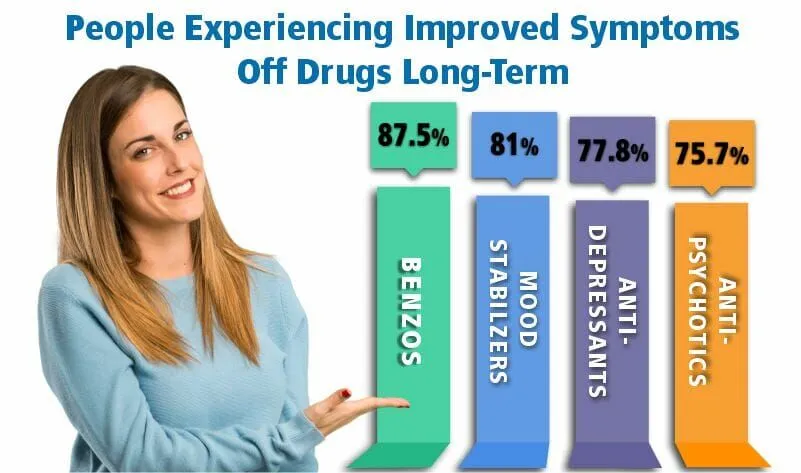
Chart illustrating reported long-term symptom improvement among individuals no longer using psychiatric medications across multiple drug categories.

An individual experiencing distress often associated with antidepressant side effects or withdrawal, highlighting the need for careful tapering and clinical support.

A quiet moment reflecting the lived experience of veterans navigating PTSD and the importance of compassionate, individualized mental health care.
Insights on withdrawal risks, gradual tapering strategies, and patient-centered support
Remeron, the brand name for mirtazapine, is classified as a tetracyclic antidepressant and is prescribed for conditions such as depression, anxiety-related disorders, sleep disturbances, and other mental health concerns. While some individuals report short-term benefits, others find that side effects, diminished effectiveness, or changes in health priorities lead them to consider tapering off the medication. Clinical experience and medical literature indicate that stopping mirtazapine abruptly can increase the risk of withdrawal symptoms and should be avoided whenever possible.
Mirtazapine discontinuation may result in a cluster of symptoms commonly referred to as antidepressant discontinuation syndrome. Individuals have reported sleep disruption, vivid dreams or nightmares, dizziness, nausea, headaches, anxiety, agitation, and sensory disturbances. These effects may be more pronounced when tapering occurs too quickly or without adequate medical guidance. Because responses vary widely, no single tapering schedule is appropriate for everyone.
“Remeron tapering is not simply about reducing a dose,” said a clinical representative for Alternative to Meds Center. “It’s about supporting the nervous system as it adapts, identifying factors that may have contributed to the original symptoms, and giving the body enough time to regain balance.”
One challenge many individuals face is that antidepressants are often prescribed during brief clinical visits, where diagnostic uncertainty may exist. Research has shown that misdiagnosis can occur, and evolving diagnostic criteria may further complicate long-term treatment decisions. In some cases, symptoms attributed to psychiatric conditions may be influenced by medical, nutritional, or medication-related factors that were not fully explored at the outset.
Medical guidance consistently emphasizes that tapering antidepressants such as mirtazapine should be done gradually. Remeron has a relatively long half-life, generally ranging from 20 to 40 hours, which can be advantageous for tapering when dose reductions are spaced appropriately. Smaller, incremental reductions allow the body time to adjust and may help reduce withdrawal intensity. Individuals often find that dose changes near the lower end of the taper require even greater care, as sensitivity may increase at reduced levels.
Alternative to Meds Center stresses that tapering is only one part of the recovery process. Without addressing underlying contributors—such as sleep disruption, nutritional deficiencies, stress physiology, or neurochemical imbalance—individuals may experience a return of symptoms after discontinuation. A comprehensive approach seeks to support long-term mental wellness rather than short-term symptom suppression.
At Alternative to Meds Center, clinical care is designed to support individuals through complex medication changes in a structured, residential setting when appropriate. Programs emphasize individualized assessment, medical monitoring, psychotherapy, nutritional and orthomolecular support, and holistic therapies aimed at stabilizing both physical and emotional health. This integrative framework is intended to help reduce distress during tapering while supporting overall recovery.
Side effects are another common reason individuals consider tapering off Remeron. While experiences vary, reported concerns have included sedation, weight changes, metabolic effects, agitation, mood instability, and in rare cases more severe reactions. For some, these effects outweigh perceived benefits, prompting a reevaluation of treatment goals. Clinical oversight is particularly important in these situations to ensure safety and to distinguish medication-related effects from underlying health conditions.
Certain populations may face additional considerations. For example, individuals who are pregnant or planning pregnancy often wish to review medication use due to potential risks. Others may question whether a prior diagnosis fully accounted for life events, medical conditions, or medication interactions that influenced symptoms. In these cases, careful reassessment and informed decision-making are essential.
Alternative to Meds Center encourages individuals considering Remeron tapering to avoid abrupt discontinuation and to seek qualified medical support. Withdrawal experiences can range from mild and short-lived to prolonged and disruptive, depending on individual factors and tapering pace. Allowing sufficient time for the process and adjusting the approach based on tolerance are key elements of safer outcomes.
Located in the red rock region of Sedona, Alternative to Meds Center has nearly two decades of experience supporting individuals who wish to safely reduce or discontinue psychiatric medications. The center’s residential programs are staffed by licensed professionals and are designed to provide a calm, supportive environment where clients can focus on healing and long-term stability.
By sharing clinical perspective on Remeron tapering, Alternative to Meds Center aims to increase understanding of antidepressant discontinuation and to encourage informed, patient-centered approaches to mental health care. Individuals and families seeking more information are encouraged to consult medical professionals and explore evidence-based resources before making changes to prescribed medications.
More information about Remeron tapering, antidepressant discontinuation, and available treatment options can be found through Alternative to Meds Center.
About Alternative to Meds Center
Alternative to Meds Center is a licensed residential mental health treatment facility based in Sedona, Arizona. For nearly 20 years, the center has helped individuals safely reduce or discontinue psychiatric medications while addressing underlying mental health challenges through medical supervision, psychotherapy, nutritional support, and holistic therapies.
Alternative to Meds Center
Alternative to Meds Center
+1 877-503-0770
email us here
Visit us on social media:
LinkedIn
Instagram
Facebook
YouTube
TikTok
X
Other
Legal Disclaimer:
EIN Presswire provides this news content "as is" without warranty of any kind. We do not accept any responsibility or liability for the accuracy, content, images, videos, licenses, completeness, legality, or reliability of the information contained in this article. If you have any complaints or copyright issues related to this article, kindly contact the author above.
